
In Michigan, refusing to attend an examination under oath (EUO) that your insurance policy requires is generally treated as a breach of your policy and can lead to denial of your claim.
There are narrow circumstances in which a demand can be challenged or delayed, such as when the request is unreasonable in scope or timing, but outright refusal without legal grounds carries a high risk.
The safest path is not refusal. It is attending the EUO with an experienced attorney who limits the scope of questioning, protects your rights, and prepares you in advance.
Henri O. Harmon represents Michigan policyholders facing an EUO demand and provides a free confidential consultation before you respond to the insurer.
What Is an Examination Under Oath, in Plain Terms
An examination under oath, commonly called an EUO, is a formal interview that your insurance company has the contractual right to conduct after you file a claim. Unlike a casual phone call with a claims adjuster, an EUO is sworn testimony. A court reporter records every question and every answer, and the transcript can later be used by the insurer to support a denial or, in some cases, by opposing counsel if the claim proceeds to litigation.
The right to demand an EUO comes directly from your policy language, typically found under a section titled Duties After Loss or Conditions. By accepting the policy, you agreed to cooperate with the insurer’s investigation, and an EUO is one of the tools insurers use to investigate a claim before deciding whether to pay it. We cover the full mechanics of the process, who can attend, and how long it typically takes on our main Michigan Examination Under Oath page.
The purpose of an EUO is not always adversarial. Some insurers request one simply to establish facts on a large or complicated claim. Increasingly, however, EUOs are used by Special Investigation Units as a tool to identify inconsistencies that can be used to delay, reduce, or deny a claim entirely. Knowing which situation you are in, and preparing accordingly, is where an experienced attorney adds the most value.
Can You Legally Refuse an EUO in Michigan?
This is the question we hear most often from policyholders who have just received a demand letter, and the honest answer is that outright refusal is rarely a safe option. Most Michigan property and casualty policies contain a cooperation clause that makes submitting to an EUO a condition of coverage. Courts in Michigan and across the country have consistently held that failure to comply with a valid EUO demand can constitute a material breach of the insurance contract.
That breach gives the insurer grounds to deny the claim outright, regardless of whether the underlying loss was legitimate. In other words, refusing the EUO does not make the insurance company’s questions go away. It simply gives them a separate, contract-based reason to close your file without paying, one that has nothing to do with the merits of your original claim.
This does not mean you have no leverage or no rights in the process. It means the leverage comes from how you respond, not from whether you respond at all.
What Happens If You Refuse or Fail to Appear
When a policyholder refuses an EUO or repeatedly fails to appear, insurers typically follow a predictable pattern. First, the insurer sends a formal notice citing the cooperation clause and warning that continued non-compliance will result in denial. If there is still no response, the insurer issues a denial letter citing breach of the policy’s post-loss conditions as the basis.
- Your claim can be denied even if the underlying loss, damage, or injury was completely legitimate.
- The denial is based on a procedural breach, which can be harder to challenge than a factual dispute about the loss itself.
- If the matter proceeds to litigation, your refusal to appear becomes part of the insurer’s defense, and can be used to argue the entire claim should be barred.
- Rebuilding trust with an insurer after a refusal is difficult, even if you later agree to appear.
There are limited exceptions. If the EUO demand is unreasonable in scope, unreasonably repetitive, or scheduled without regard for a documented medical or personal emergency, an attorney can object, negotiate new terms, or in rare cases challenge the demand. These are narrow, fact-specific arguments, not a general right to decline participation, and they are far more effective when raised by counsel than when a policyholder simply stops responding.
Are There Any Valid Reasons to Delay or Object
Delay is different from refusal, and this distinction matters. An attorney representing you can often negotiate the date, location, and format of an EUO without jeopardizing your claim. Common, legitimate reasons to request a delay or narrow the scope include a documented medical condition that prevents travel or lengthy testimony, an unreasonably short notice period that does not allow time to gather requested documents, or a request that goes far beyond what is relevant to the claim, such as questions about unrelated financial history.
The key difference between a reasonable objection and an outright refusal is intent and communication. An attorney who formally requests a two-week extension while continuing to cooperate protects your position. A policyholder who simply stops answering the insurer’s calls does not.
It also matters who is asking. Insurers are far more willing to accommodate a scheduling request from counsel on official letterhead than an informal request from the policyholder. This is partly a matter of process, since claims departments are structured to respond to attorney correspondence through their legal or SIU channels, and partly a matter of leverage, since an insurer knows that an unreasonable refusal to accommodate a documented medical need could later be used against them if the claim proceeds to litigation.
What Documents the Insurer Will Likely Request Before the EUO
Most EUO demand letters arrive with an accompanying document request, sometimes lengthy, asking the policyholder to produce records before the examination takes place. Understanding what is typically requested and what is reasonable to provide helps you prepare without overdisclosing information beyond the scope of your claim.
- The insurance policy and any prior correspondence related to the claim
- Proof of ownership for damaged or lost property, such as receipts, titles, or appraisals
- Photographs or video documenting the loss and the condition of the property beforehand
- Repair estimates, invoices, or contractor bids related to the claimed damage
- Tax returns or financial records, typically limited to specific years and only when directly relevant to the claim
- Prior claims history with the same or other insurers, when relevant to a pattern the insurer is investigating
Some of these requests are entirely standard. Others, particularly broad requests for years of financial records or unrelated medical history, can exceed what is reasonably necessary to evaluate the claim. An attorney reviewing the request before you respond can identify which categories are appropriate to produce and which should be narrowed or objected to, rather than leaving that judgment call to the policyholder under time pressure.
Common Mistakes That Hurt Your Claim at an EUO
Even policyholders with legitimate, well-documented claims can damage their own case during an examination under oath simply by not knowing what to expect. The mistakes below are the ones we see most often, and nearly all of them are preventable with proper preparation.
- Volunteering information beyond what the question actually asked, which opens the door to follow-up questions on topics that were never part of the original claim
- Guessing at dates, amounts, or details rather than saying you do not recall, which can later look like a misrepresentation if the guess turns out to be inaccurate
- Failing to review the claim file and prior statements beforehand, leading to answers that unintentionally contradict something already on record
- Treating the examiner as a neutral party rather than an advocate for the insurer, which can lead to an overly casual or overly cooperative tone
- Arriving without an attorney and without a clear understanding of the right to request breaks or clarification during the session
None of these mistakes reflect dishonesty on the part of the policyholder. They reflect the natural result of walking into a formal legal proceeding without preparation or representation, which is precisely the gap an experienced EUO attorney closes.
Who Can Be Required to Attend an EUO
Policyholders are often surprised to learn that they may not be the only person the insurer wants to examine. Most policy language extends the cooperation clause to anyone who qualifies as an insured under the policy, which may include a spouse, other household members, business partners on a commercial policy, or employees who assisted in preparing or submitting the claim.
This matters for two reasons. First, if the insurer requests an EUO from a family member or business partner, that person has the same rights and faces the same risks as the primary policyholder, including the right to bring an attorney. Second, testimony given by one household or business member can affect the entire claim if it conflicts with what another member said. Coordinating representation across everyone the insurer intends to examine is one of the first things we assess when a new EUO matter comes in.
Why You Should Never Attend an EUO Without an Attorney
Michigan law and most insurance policies give you the right to have an attorney present at your examination under oath, and this is one of the most important protections available to you. An EUO is not a casual conversation. Insurance company attorneys conducting these examinations are trained to ask layered questions designed to surface inconsistencies, and answers that seem harmless in the moment can later be used to argue you misrepresented facts on your claim.
An experienced EUO attorney does several things a policyholder cannot do alone. We review your claim file and policy language before the examination so there are no surprises. We object on the record when questions exceed the proper scope of the examination. We prepare you in advance so you understand what will be asked and how to answer truthfully without volunteering unnecessary information. We also ensure the transcript accurately reflects your testimony, since transcription errors can occur and matter later.
The comparison below illustrates why attending with counsel consistently produces better outcomes than either refusing the EUO or attending without representation.
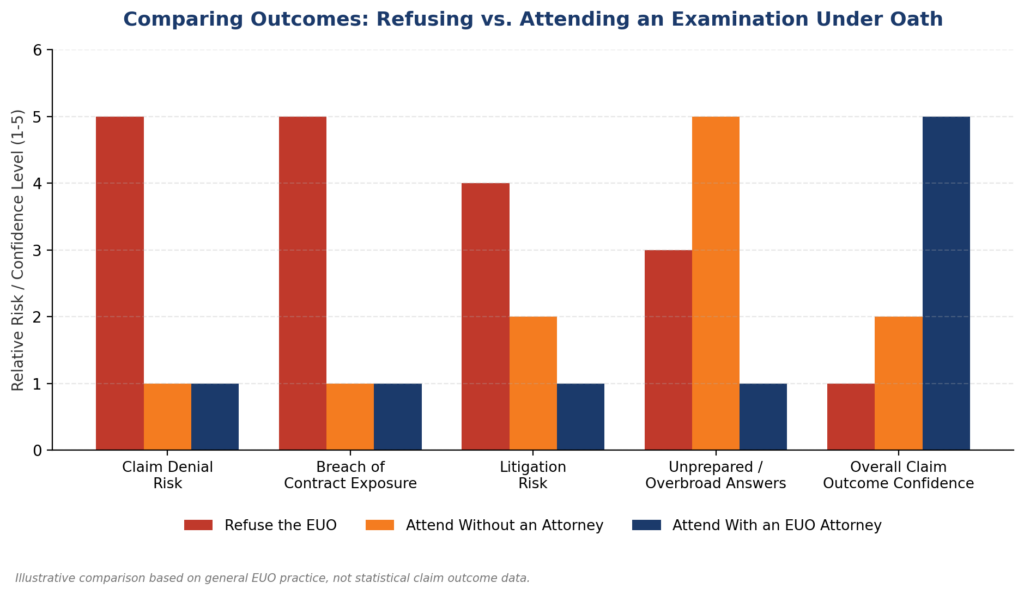
Figure 1. Illustrative comparison of risk levels across the three common paths policyholders take when facing an EUO demand.
The EUO Process From Start to Finish
Understanding the sequence of events helps reduce the anxiety that comes with an EUO demand letter. While every insurer and every claim moves at a slightly different pace, most Michigan EUOs follow the general timeline below.
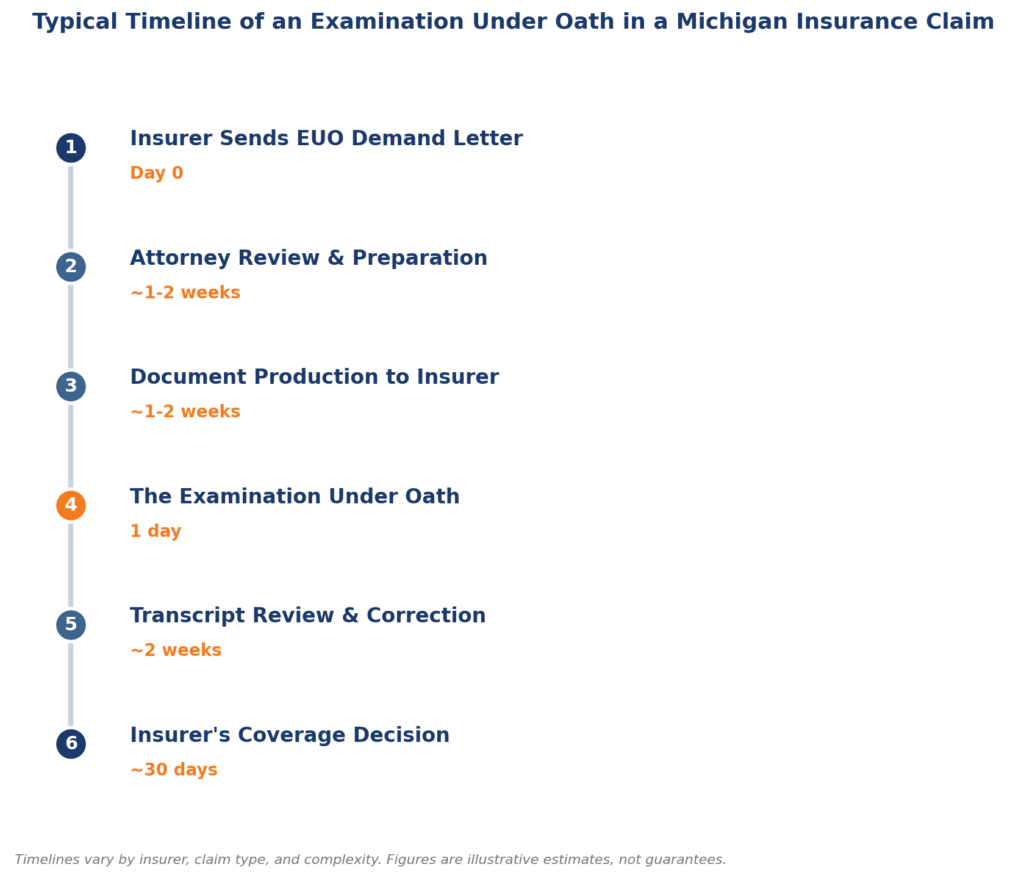
Figure 2. A typical timeline from EUO demand letter to the insurer’s coverage decision. Actual timelines vary by insurer and claim complexity.
What Happens After the Examination Under Oath
Once the EUO concludes, the court reporter prepares a written transcript, usually within two to three weeks. You have the right to review this transcript for accuracy and to submit corrections through an errata sheet before it is finalized. This step is easy to overlook, but it matters, since the transcript becomes the official record of your testimony.
After the transcript is finalized, or sometimes even before, the insurer’s claims department and Special Investigation Unit review your answers alongside the rest of the claim file. They are looking for consistency between your EUO testimony, your original claim application, any recorded statements, and supporting documentation such as receipts, photos, or medical records.
From there, the insurer will either approve the claim for payment, request additional documentation, or issue a denial. If your claim is denied following an EUO, you are not without options. Michigan policyholders can dispute a denial, and in appropriate cases pursue litigation against the insurer, particularly where the denial appears to be based on a technicality rather than a genuine dispute about coverage.
It is worth noting that a completed EUO does not guarantee a favorable outcome, and it does not guarantee an unfavorable one either. What it does is close off the procedural argument an insurer would otherwise have for denying your claim outright. From that point forward, any dispute over coverage has to be argued on the merits of the claim itself, which is a far better position for a policyholder than facing a denial rooted in non-cooperation.
How Henri O. Harmon Prepares Clients for an EUO
We represent Michigan policyholders from the moment an EUO demand letter arrives through the insurer’s final coverage decision. Our process begins with a free confidential consultation where we review your policy, your claim file, and the specific demand letter you received. From there, we handle communication with the insurer directly, so you are not navigating adjuster calls and legal deadlines on your own.
Before the examination itself, we prepare you thoroughly. This includes a plain language walkthrough of what will be asked, guidance on answering truthfully and concisely, and a clear understanding of your rights during the session, including the right to a break and the right to have your attorney object on the record. We attend the EUO with you, and we follow through afterward by reviewing the transcript and advocating for a fair outcome on your claim.
Frequently Asked Questions
Can I have a lawyer speak for me at an examination under oath?
Your attorney cannot answer questions on your behalf, since the testimony must come from you, but your attorney can object to improper questions, request breaks, clarify the scope of questioning, and advise you throughout the session. Having counsel present is one of the most important protections available during an EUO.
Can I refuse to answer specific questions during the EUO?
You can object through your attorney if a question is clearly outside the proper scope of the claim, but refusing to answer questions that are relevant to your claim carries the same risks as refusing the entire examination. An attorney can help distinguish between questions you must answer and questions that are genuinely improper.
What if I already gave a recorded statement to the insurance company?
A prior recorded statement does not exempt you from a subsequent EUO demand. Insurers often request an EUO specifically because they want sworn testimony that carries more legal weight than an informal recorded statement. Any inconsistencies between the two can become a focus of the examination, which is another reason to have an attorney review both before you appear.
Will hiring an attorney for my EUO slow down my claim?
In most cases, attorney involvement does not meaningfully slow the process and often speeds resolution by keeping communication with the insurer organized and responsive. What it does change is the quality of the outcome, since a well prepared EUO reduces the risk of a denial based on inconsistent or incomplete testimony.
Does refusing an EUO affect only my current claim, or future claims too?
A denial based on failure to cooperate is generally specific to the claim in question, but insurers do keep internal claim histories, and a documented pattern of non-cooperation can influence how future claims with the same carrier are handled. This is another reason to resolve an EUO dispute properly through counsel rather than simply avoiding the process.
Talk to a Michigan EUO Attorney Before You Respond
If you have received a demand for an examination under oath, the decision you make in the next few days can shape the outcome of your entire claim. Refusing outright puts your claim at serious risk. Attending unprepared puts your claim at a different kind of risk. The safest path is to speak with an attorney who regularly handles EUOs before you respond to the insurer at all.
Contact Henri O. Harmon today for a free confidential EUO consultation. We will review your demand letter, explain your rights under Michigan law, and build a plan to protect your claim from the very first step.
There is no cost and no obligation to speak with us, and doing so before you respond to the insurer, rather than after, is what gives you the most options. Whether you have just received a demand letter this week or you are already deep into a claim dispute that now involves an EUO request, we are ready to review your situation and walk you through exactly what comes next.