
A Policyholder’s Guide to EUO Demands, Rights, and Legal Representation
An Examination Under Oath (EUO) is a sworn, recorded interview an insurance company can require as a condition of coverage under a Michigan property insurance policy. Insurers use EUOs to investigate claims, screen for fraud, and verify coverage before paying. Failure to comply with a valid EUO request may jeopardize coverage or prevent the insured from pursuing a lawsuit. Michigan policyholders facing an EUO letter should consult an attorney before responding, since the examination can directly determine whether a claim is paid, delayed, or denied.
Receiving a letter demanding an Examination Under Oath is one of the more unsettling moments in the life of an insurance claim. The letter is formal, the language is unfamiliar, and the deadline is often short. This guide explains what an Examination Under Oath is under Michigan law and property insurance policies, why insurers request one, what policyholders are required to do, and the role an attorney may play before and during an EUO.

What Is an Examination Under Oath?
An Examination Under Oath, commonly abbreviated as EUO, is a formal interview conducted under oath in which a policyholder answers questions from the insurance company’s attorney about a claim. Unlike a phone call with a claims adjuster, a court reporter records an EUO, and the policyholder’s answers are transcribed into sworn testimony. That testimony becomes part of the claim file and the insurer can use it to support a coverage decision, including a denial.
The obligation to sit for an EUO does not come from state statute alone. It comes from the insurance policy itself. Nearly every Michigan homeowners and commercial property policy contains a cooperation clause, sometimes titled “Duties After Loss,” that requires the policyholder to submit to an EUO if the insurer requests one. Because this obligation is written into the contract the policyholder signed, Michigan courts have consistently enforced it, and an insurer’s EUO request is difficult to challenge on procedural grounds alone.
How an EUO Differs From a Recorded Statement
Many policyholders confuse an EUO with the recorded statement an adjuster requests early in a claim. A recorded statement is informal, often conducted over the phone, and generally covers the basic facts of the loss. An EUO is a formal contractual examination conducted as part of the insurer’s claim investigation. It often resembles a deposition because the policyholder gives sworn testimony before a court reporter, but it ordinarily occurs outside a lawsuit and is governed primarily by the insurance policy and applicable law. Attorneys are present, and the process can last several hours. Questions go beyond the loss itself and often extend into the policyholder’s finances, prior claims history, and ownership records.
Why Insurers Demand an EUO
Insurance companies do not request an EUO on every claim. When they do, it typically signals that the insurer wants a closer look before authorizing payment. The reasons generally fall into a few recurring categories.
- Coverage verification. The insurer wants to confirm the policy was in effect, the property matches what is described in the application, and the loss falls within the covered perils.
- Fraud screening. Insurers use EUOs as a primary tool to investigate suspected misrepresentation, inflated damage estimates, or inconsistencies between the initial report and later documentation.
- Claim amount discrepancies. When a repair estimate, contractor bid, or public adjuster estimate differs significantly from the insurer’s own inspection, an EUO is used to probe the difference.
- Prior claims history. A history of previous claims on the same property, or claims filed shortly after a policy was purchased or increased, often triggers closer scrutiny.
- Documentation gaps. Missing receipts, unclear ownership records, or incomplete proof-of-loss forms can prompt an insurer to request sworn testimony to fill in the gaps.
Policyholders should understand that an EUO request is not, by itself, an accusation of wrongdoing. Many legitimate claims involve an EUO simply because of the loss amount or the type of policy. What matters is how the policyholder prepares and responds.
Your Rights and Risks
Michigan policyholders have real rights during the EUO process, but those rights come with real risks if they don’t comply.
What You Must Do
- Attend the EUO within a reasonable time after it is requested, in accordance with the policy’s cooperation clause.
- Answer questions truthfully and completely, since the testimony is given under oath.
- Provide documents required by the policy and reasonably related to the insurer’s investigation, subject to any appropriate legal objections.
What Is at Stake if You Do Not Comply
- Outright claim denial. Refusing to attend an EUO, or attending but refusing to answer material questions, may jeopardize your claim.
- Testimony used against you later. Anything said in an EUO may be used in a later lawsuit if the claim is denied and litigation follows.
A Note on Cooperation Clauses: Michigan courts generally recognize that compliance with a valid EUO provision may be a condition precedent to maintaining an action or recovering under the policy. The result of noncompliance may depend on the policy language, whether the insured substantially complied, and whether the noncompliance was willful. This is one of the main reasons policyholders should not ignore or delay responding to an EUO letter.

The EUO Process, Step by Step
While every claim is different, the path from an EUO demand letter to a final coverage decision generally follows the same structure.
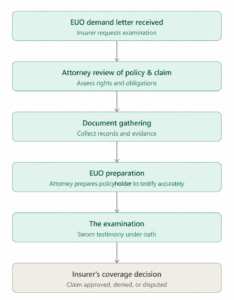
Step 1: The EUO Demand Letter. The process begins when the insurer sends a formal letter invoking the policy’s EUO provision. The letter typically names a date, time, and location, and may request specific documents in advance.
Step 2: Attorney Review of the Policy and Claim. Before the EUO, an attorney reviews the policy language, the claim history, and the correspondence exchanged with the insurer.
Step 3: Document Gathering. The policyholder and their attorney assemble the documentation the insurer is entitled to review, including proof of ownership, repair estimates, and photographs.
Step 4: EUO Preparation. The attorney walks the policyholder through the likely lines of questioning.
Step 5: The Examination. The EUO itself is conducted with a court reporter present. The policyholder’s attorney may provide legal advice, raise appropriate objections, address issues involving privilege or the scope of the policy’s requirements, and preserve issues in the record.
Step 6: The Insurer’s Coverage Decision. After reviewing the transcript, the insurer issues a coverage decision. This may result in payment, a request for additional information, a delay, or a challengeable denial.
When to Involve an Attorney
Some policyholders wait to involve an attorney until after the insurer has already denied a claim. In an EUO situation, that is often too late, since the testimony given at the examination is frequently the deciding factor in the insurer’s decision. Involving an attorney before the EUO allows potential coverage and evidentiary issues to be identified before sworn testimony is given. An experienced attorney changes the EUO process in several concrete ways. Attorney Henri O. Harmon reviews the policy and claim file to identify what the insurer is investigating, prepares the policyholder for likely questions, and attends the examination to object to improper questions and preserve the record. Because Mr. Harmon has litigated complex insurance and commercial disputes in courts across multiple states, he understands how to identify potential coverage issues, prepare the policyholder to answer accurately, and preserve relevant issues in the claim record.
Signs You Should Not Wait
- The EUO letter requests financial records, tax returns, or bank statements.
- The claim involves a large loss, a total loss, or a fire investigation.
- There have been prior claims on the same property within the last several years.
- The insurer has already delayed the claim or requested a recorded statement that felt adversarial.
- You are unsure why the EUO was requested in the first place.
Free Confidential EUO Consultation: Do not ignore the EUO request. Promptly consult an attorney before providing substantive responses, producing disputed documents, or appearing for the examination. Attorney Henri O. Harmon offers a free, confidential consultation to review your letter, explain what the insurer is investigating, and outline your options before you attend the examination.
Frequently Asked Questions
Is an Examination Under Oath the same as a deposition?
It is similar in format, since both involve sworn testimony recorded by a court reporter, but an EUO takes place outside of a lawsuit as part of the insurer’s claim investigation, while a deposition occurs after a lawsuit has been filed.
Does an EUO Request Mean that My Claim Will Be Denied?
Requesting an EUO does not mean the insurer will deny a claim. It means the insurer wants more information before deciding. The completeness, accuracy, and consistency of the policyholder’s EUO testimony may affect the insurer’s evaluation and may become important in any later dispute.
What happens if I miss my EUO date?
Missing an EUO date without a valid reason may be treated as a failure to cooperate, which may give the insurer grounds to deny the claim. If you can’t attend a scheduled EUO, contact an attorney immediately to request a reasonable accommodation.
Will my answers during the EUO be used if I have to file a lawsuit later?
Yes. EUO testimony becomes part of the claim file and may be introduced as evidence if the claim is later denied and the policyholder pursues litigation, which is why accurate and carefully prepared testimony matters from the start.
Received an EUO Letter? Talk to an Attorney First.
Call 947-777-0726 or schedule your free confidential EUO consultation online before you respond to your insurance company.