


Insurers ask examination under oath questions in a few predictable categories: background and policy details, loss timeline, property or injury specifics, financial records, and prior claims history.
Questions are designed to establish consistency between your testimony and your claim file. Vague or evasive answers, and equally, guessed or overly detailed answers, can create problems later.
The strongest approach is to answer truthfully, answer only what was asked, and say you do not recall rather than guess.
Reviewing likely questions with an attorney beforehand meaningfully changes the experience, from confidence during questioning to the risk of follow-up scrutiny.
[Henri O. Harmon] (placeholder — link to firm bio page once relative path is confirmed) prepares Michigan policyholders for their EUO with a full walkthrough of likely questions before the examination.
Why Knowing the Questions in Advance Matters
An examination under oath can feel unpredictable if you do not know what is coming. In practice, EUO questioning follows a fairly consistent structure across most Michigan insurance claims, whether the loss involves property damage, a fire, an auto claim, or an injury. Knowing the general categories of questions ahead of time removes much of the uncertainty and lets you focus on answering accurately rather than being caught off guard.
This page walks through the types of questions you are likely to face, along with guidance on how to answer them. For a broader overview of the examination process itself, including who can attend and what happens afterward, see our main page on the Michigan examination under oath process.
It is worth saying plainly that none of this preparation is about coaching you to say anything other than the truth. The goal is the opposite. Preparation helps you communicate the truth clearly, accurately, and without the kind of nervous over-explaining or guessing that can accidentally create the appearance of inconsistency where none actually exists.
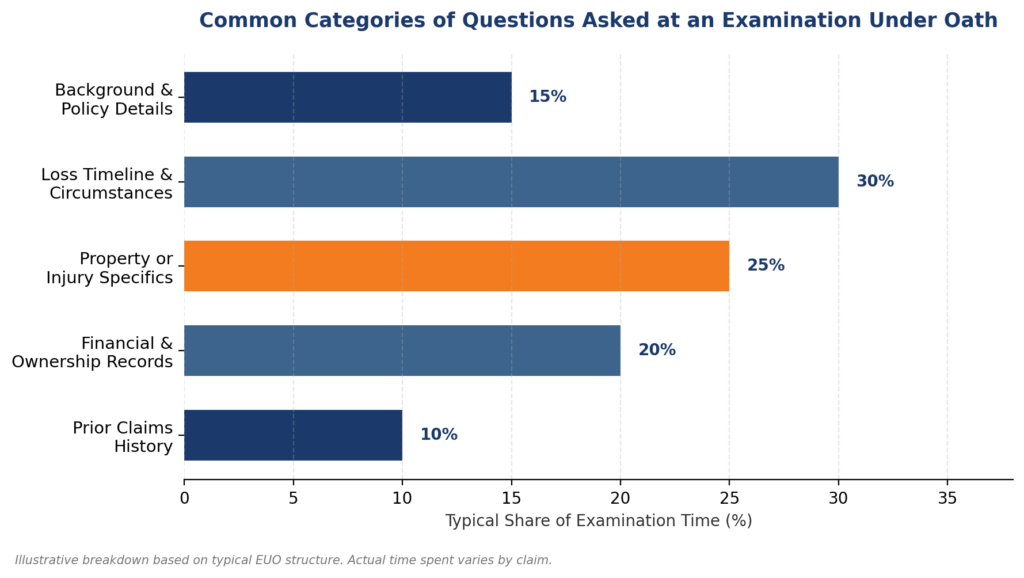
Figure 1. A typical breakdown of how examination time is spent across question categories. Actual time varies by claim type and complexity.
Background and Policy Questions
The examination usually opens with foundational questions meant to establish who you are, your relationship to the policy, and the basic facts of your coverage. These questions are rarely difficult, but they set the tone for the rest of the session and establish a baseline the examiner will refer back to later.
- Please state your full name and current address for the record
- What is your relationship to the insured property or vehicle
- How long have you held this insurance policy, and has the coverage changed over that time
- Who else resides in your household or has an ownership interest in the property
- Have you reviewed your policy, and do you understand the coverage it provides
Answer these plainly and accurately. There is little strategic value in hedging on background questions, and doing so can make an examiner more skeptical of your later answers than the facts actually warrant.
Loss Timeline and Circumstances Questions
This category typically takes up the largest share of the examination, since it goes directly to what happened, when it happened, and how you responded. Expect detailed, sequential questions about the loss itself.
- Walk me through the events of the day the loss occurred, from the beginning
- What time did you first notice the damage or discover the loss
- Who did you contact first, and what did you tell them
- Were there any witnesses present, and can you provide their contact information
- Have you made any repairs or changes to the property since the loss occurred
Precision matters here more than anywhere else in the examination. If you are unsure of an exact time or sequence, say so rather than estimating with false confidence. Examiners are trained to probe inconsistencies in timelines, and a well-intentioned guess that turns out to be wrong can look worse than an honest I do not recall exactly.
A practical way to prepare for this section is to build your own written timeline before the examination, working from whatever records you already have, such as text messages, photos with timestamps, or receipts. Reviewing that timeline with your attorney beforehand does two things at once. It refreshes your memory of the actual sequence of events, and it surfaces any gaps or inconsistencies while there is still time to address them, rather than discovering them for the first time under oath.
Property or Injury Specifics
Questions in this category focus on the details of what was damaged, lost, or injured, and how you know what you know. For property claims, expect detailed questions about the items or structure affected. For injury claims, expect detailed questions about the nature and extent of the injury.
- Describe the condition of the property immediately before the loss occurred
- How do you know the value or age of the items you are claiming
- Do you have receipts, photographs, or appraisals to support the claimed value
- For injury claims, what symptoms did you experience and when did they begin
- Have you sought medical treatment, and from which providers
This is an area where thorough preparation with your attorney beforehand pays off directly, since gathering documentation ahead of the examination lets you answer these questions with specifics rather than approximations.
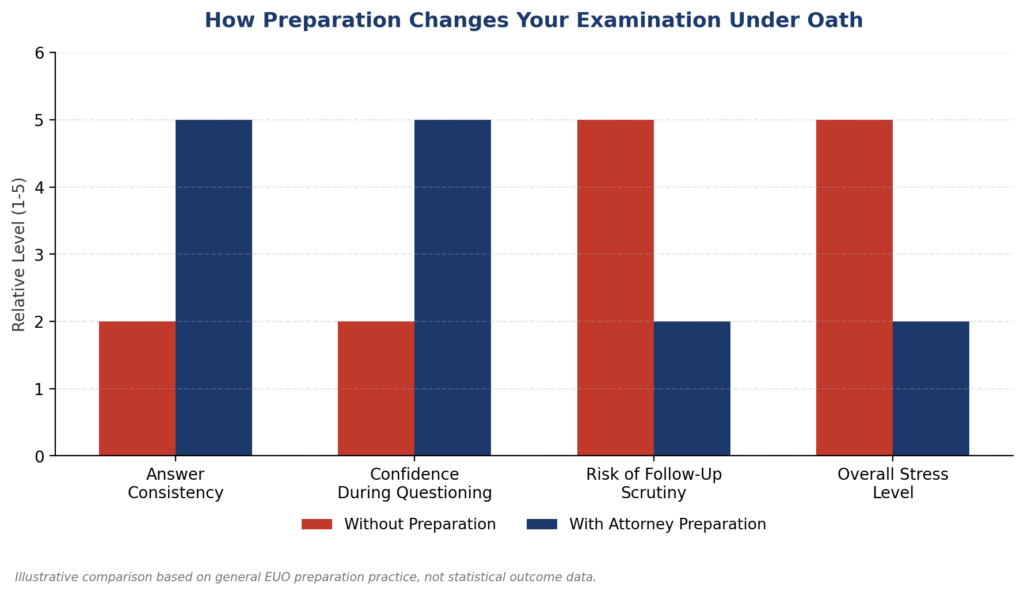
Figure 2. Attorney preparation changes both how the examination feels and how it holds up under scrutiny afterward.
Financial and Ownership Records Questions
Insurers use financial questions to verify ownership and confirm that the claimed loss aligns with your actual financial history. These questions can feel more invasive than others, which is exactly why an attorney’s presence matters here.
- How did you originally acquire the property or item being claimed
- What was the purchase price, and do you have documentation of the purchase
- Do you have any outstanding loans, liens, or financing tied to the property
- Have you filed for bankruptcy or had any significant financial changes recently
Some financial questions are legitimate and relevant to the claim. Others can stray beyond what is reasonably necessary to evaluate the loss. An attorney present at the examination can object when a question moves outside proper scope, which is one of the clearest, practical reasons to have representation at this stage.
Policyholders sometimes worry that financial questions signal that the insurer specifically suspects fraud. In most cases, this is simply standard verification, since ownership and value are core elements of any property claim regardless of how straightforward the loss appears. That said, if financial questions begin extending well beyond the scope of the claimed loss, such as requests for years of unrelated bank statements or tax returns with no clear connection to the claim, that is precisely the kind of overreach an attorney is positioned to push back on during the examination itself.
Prior Claims History Questions
Insurers routinely ask about your history with other claims, both with this carrier and with previous insurers. This is standard practice and not, by itself, a sign that your claim is under special suspicion.
- Have you filed any other insurance claims in the past five to ten years
- What was the outcome of those prior claims
- Have you ever had a claim denied or a policy canceled by an insurer
Answer honestly, even if a prior claim was denied or contested. Insurers can often verify claims history independently, and an inaccurate answer here does far more damage to your credibility than an honest answer about a past denial ever would.
Follow-Up Questions and Why They Happen
It is common for an examiner to ask the same underlying question two or three different ways across the course of an EUO. This is not necessarily a sign of suspicion. Examiners are trained to test consistency, and asking about the same fact from a different angle later in the session is a standard technique, not an accusation.
The right response to a follow-up question is the same as your original answer, given honestly and without over-explaining. If your answer changes because you genuinely remember something new, say so plainly, since correcting yourself honestly is far less damaging than trying to smooth over an inconsistency. What creates real problems is when a policyholder, feeling pressured, starts adjusting earlier answers to sound more consistent with a later one. That instinct, however natural, is usually what turns a minor discrepancy into a credibility issue.
Documents You May Be Asked to Reference During Questioning
Many EUO questions are asked with a specific document in front of the examiner, and sometimes in front of you as well. Being familiar with your own file before the examination makes these moments far less stressful.
- Your original insurance policy and any endorsements or riders
- The proof of loss form or claim application you originally submitted
- Photographs or video you provided documenting the loss
- Repair estimates, invoices, or receipts already in the claim file
- Any prior recorded statement or written correspondence with the adjuster
If you are shown a document you do not immediately recognize or recall, it is entirely appropriate to ask for a moment to review it before answering a question about its contents. Rushing to answer about a document you have not actually read carefully is one of the more avoidable mistakes we see policyholders make.
How to Answer Any Question at Your EUO
Regardless of category, a few core principles apply to every question you are asked during the examination.
- Listen to the full question before answering, and ask for clarification if any part of it is unclear
- Answer only what was asked. Do not volunteer additional information the question did not request
- If you do not know or do not recall, say so directly rather than guessing or estimating
- Take your time. There is no penalty for pausing to think before you answer
- If your attorney objects to a question, wait for guidance before answering
These principles sound simple, but they are easy to abandon under the pressure of a formal examination. This is exactly why reviewing likely questions with your attorney beforehand makes a measurable difference, since practicing the discipline of answering only what is asked, in a low-pressure setting, makes it far easier to do the same thing under oath.
Common Mistakes to Avoid When Answering
Beyond the core principles of answering honestly and only what is asked, a few specific habits tend to cause the most trouble for policyholders who have not prepared beforehand.
- Filling silence. A pause before an answer feels uncomfortable, but it is not a problem. Rushing to fill that silence with extra detail often creates more follow-up questions than it prevents
- Speculating about someone else’s motives or actions, such as guessing why a contractor was late or what an adjuster was thinking. Stick to what you personally know
- Arguing with the examiner or becoming visibly frustrated. The examination is not the venue to win an argument about the claim, and a calm, cooperative tone serves you far better than a defensive one
- Treating a casual aside as off-the-record. Everything said during the examination, including comments made while a document is being located or a break is being discussed, is part of the record
None of these mistakes reflect dishonesty. They reflect the natural human instinct to fill an uncomfortable silence, defend oneself, or over-explain. Recognizing these instincts in advance, ideally through a practice session with your attorney, is often enough to prevent them from surfacing during the actual examination.
How Henri O. Harmon Prepares You for Your EUO
Before your examination, we walk through the categories of questions above in detail, tailored to the specifics of your claim. We review your claim file together, identify any documentation gaps worth closing before the session, and talk through how to handle the questions most likely to be difficult given your particular circumstances.
We attend the examination with you, object when questions exceed the proper scope, and remain available afterward to review the transcript and address whatever comes next. Preparation does not eliminate every hard question, but it removes the uncertainty that makes hard questions feel overwhelming.
Every claim is different, and the questions most likely to matter in your examination depend heavily on the specifics of your loss, your policy, and your claim history. That is exactly why we build preparation around your file rather than a generic checklist. A property claim following a fire raises different concerns than an auto claim following a collision, and a commercial policy raises different concerns than a personal one. Working through your specific situation before the examination, rather than on the day of, turns preparation into genuine confidence rather than last-minute memorization.
Frequently Asked Questions
Can I refuse to answer a specific question during my EUO?
You can object through your attorney if a question is clearly outside the proper scope of the claim, but refusing to answer a relevant question carries real risk. Your attorney can help distinguish between a question you should answer and one that is genuinely improper before you respond.
What if I honestly do not remember the answer to a question?
Say so directly. I do not recall is a complete, honest answer, and it is far safer than guessing at a detail you are not sure about. Insurers are far more concerned with consistency and honesty than with a policyholder’s perfect memory for every detail.
Will the insurer ask questions unrelated to my specific claim?
Insurers are generally limited to questions relevant to evaluating your claim, though the boundaries of relevance can be interpreted broadly. If a question feels far outside the scope of your loss, your attorney can object on the record.
How long does an examination under oath typically last?
Most EUOs last a few hours, though the exact length depends on the complexity of the claim and the number of documents involved. Straightforward claims may conclude in under two hours, while complex or high-value claims can extend longer.
Should I bring my own documents to the examination?
Only bring what the demand letter specifically requests, unless your attorney advises otherwise. Bringing additional, unrequested documents can open the door to questions about material you were not obligated to produce, so it is worth reviewing exactly what has been asked for before you show up.
Prepare for Your EUO With a Michigan Attorney
Walking into an examination under oath without knowing what to expect puts you at a disadvantage before the first question is even asked. Contact Henri O. Harmon today for a free confidential EUO consultation. We will review your claim, walk through the questions specific to your situation, and make sure you are ready before you are ever under oath.
There is no cost and no obligation to speak with us, whether your examination is scheduled for next week or you are still deciding how to respond to a demand letter you just received.